
Hand Surgery
Hand Cancers
“When cancer challenges the hand, precision, planning, and reconstruction help it rise again — strong, steady, and scarless in spirit.”
Cancers of the hand are rare but serious conditions that arise from the skin, soft tissues, or bones. Because the hand is such a complex and vital structure, early recognition and specialist care are essential to preserve both function and appearance.
Hand cancers may begin as painless lumps, non-healing ulcers, or changing skin lesions, often mistaken for benign growths at first. However, their behavior — rapid growth, pain, ulceration, or fixation to deeper tissues — can signal something more concerning.
Squamous Cell Carcinoma (SCC)
-
Description: The most common skin cancer of the hand, often developing on sun-exposed areas or chronic wounds (Marjolin’s ulcer).
-
Features: A scaly, crusted, or ulcerated lesion that may bleed or fail to heal.
-
Treatment: Surgical excision with clear margins; advanced cases may require skin grafts or flap reconstruction.

Basal Cell Carcinoma (BCC)
-
Description: A slow-growing cancer arising from the basal layer of the skin; rarely spreads but can cause significant local damage.
-
Features: Pearly, raised edge with a central ulcer (“rodent ulcer”).
-
Treatment: Wide local excision or Mohs micrographic surgery for margin control.

Malignant Melanoma
-
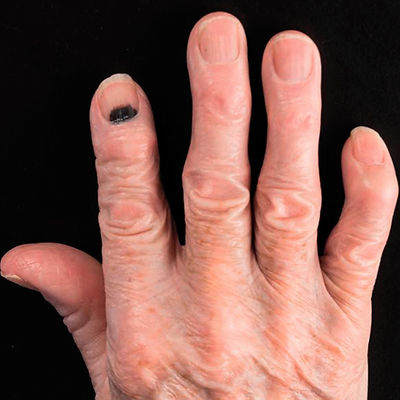
Description: A potentially aggressive cancer originating from pigment-producing melanocytes; often appears under the nail (subungual melanoma) or on the palm.
-
Features: A dark, irregular patch or streak that may bleed or change shape/color; may look like a stubborn “bruise” under the nail.
-
Treatment: Wide excision or amputation depending on stage, with lymph node evaluation and oncologic follow-up.
Keratoacanthoma
-
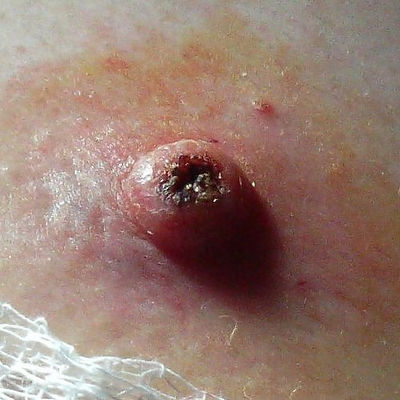
Description: A rapidly growing lesion that mimics squamous cell carcinoma.
-
Features: Dome-shaped, with a central keratin plug; may regress spontaneously.
-
Treatment: Surgical excision for diagnosis and cure.
Merkel Cell Carcinoma
-
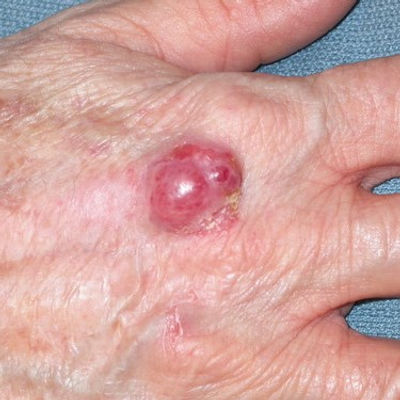
Description: A rare but aggressive neuroendocrine skin tumor, typically seen in elderly or immunocompromised individuals.
-
Features: A fast-growing, firm, reddish nodule on sun-exposed areas.
-
Treatment: Wide excision, sentinel lymph node biopsy, and radiotherapy.
Chondrosarcoma
-
Description: The most common primary malignant bone tumor of the hand, originating from cartilage.
-
Features: Gradual swelling, dull pain, and sometimes pathological fracture.
-
Treatment: Wide surgical excision or ray amputation; resistant to chemotherapy and radiotherapy.

Osteosarcoma
-
Description: A high-grade malignant tumor producing bone-forming cells (osteoid).
-
Features: Painful swelling, rapid progression, and sometimes warm overlying skin.
-
Treatment: Wide excision or amputation, with adjuvant chemotherapy.

Ewing’s Sarcoma
-
Description: A rare, aggressive tumor typically affecting children and young adults.
-
Features: Pain, swelling, warmth, and occasionally systemic symptoms (fever, malaise).
-
Treatment: Multimodal therapy — chemotherapy, surgery, and radiotherapy.

Metastatic Lesions
-
Description: Secondary deposits from cancers elsewhere (lung, breast, kidney, etc.). Picture shows hand metastasis from renal carcinoma.
-
Features: Painful swelling or pathological fracture without preceding trauma.
-
Treatment: Depends on primary cancer; may include palliative surgery or radiotherapy for pain relief and stabilization.

Book Consultation — Hand Cancer Treatment in Pakistan
Dr. Saud Majid is a plastic and cosmetic surgeon practicing since 2020, providing specialized diagnosis, surgical excision, and reconstruction for hand cancers, with focus on oncological safety, limb preservation, and functional recovery.
For early evaluation and expert management:
Consultation includes:
-
detailed lesion assessment.
-
biopsy planning or review.
-
treatment and reconstruction discussion.
-
follow-up and surveillance guidance.