
Reconstructive & Burn Surgery
Hemangiomas & Vascular Malformations
“Not every red mark tells a story—some just need a little rewriting by a skilled hand.”
What are Hemangiomas & Vascular Malformations?
A hemangioma and a vascular malformation are both conditions involving abnormal blood vessels, but they differ in how and when they develop.
A Hemangioma is a benign vascular tumor that usually appears shortly after birth. It grows rapidly during infancy and then slowly fades over time—often disappearing on its own or with minimal treatment.
A Vascular Malformation, on the other hand, is a structural abnormality of blood vessels that is present at birth and grows steadily with the child. It doesn’t regress on its own and may involve veins, arteries, capillaries, or lymphatic vessels—or a combination of these.
Diagnosis
Diagnosis is based on:
-
detailed clinical examination.
-
ultrasound or Doppler studies.
-
MRI or CT scan when required.
Accurate diagnosis helps differentiate hemangiomas from vascular malformations and guides treatment.
Treatment of Hemangioma and Vascular Malformations
Treatment depends on the type, size, and location of the lesion, as well as how it affects appearance or function.
Hemangiomas often shrink on their own over time, but when they grow rapidly or interfere with vision, breathing, or feeding, early treatment may be needed. Options include oral medications (like propranolol), laser therapy, or surgical removal for resistant cases.
Vascular malformations, in contrast, do not regress spontaneously and usually require more active management. Depending on whether they involve veins, arteries, or lymphatic channels, treatments may include sclerotherapy (injecting a solution to shrink abnormal vessels), laser therapy to reduce discoloration, or surgery to remove or reconstruct affected tissue.
A multidisciplinary approach ensures both functional and aesthetic outcomes are optimized, helping patients regain comfort and confidence.

Infantile Hemangioma
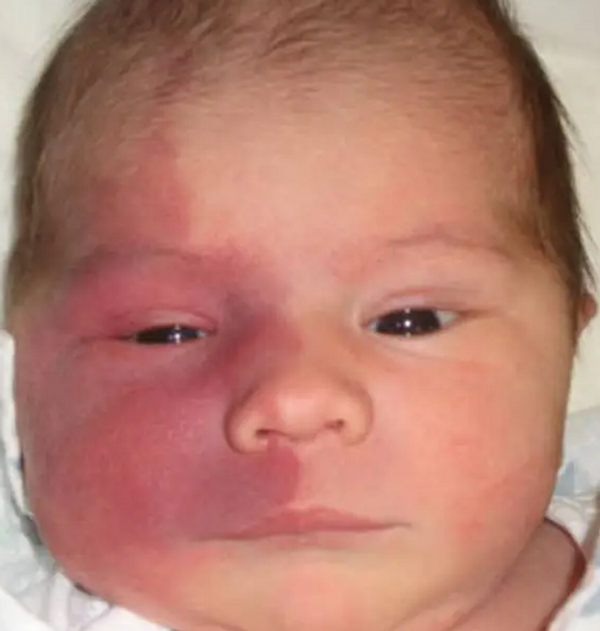
Capillary Malformation
Timing of Treatment
The timing of treatment depends on the type of lesion and how it behaves over time.
For hemangiomas, early assessment—ideally within the first few weeks of life—is important. Many small hemangiomas need only observation, as they often shrink naturally by school age. However, rapidly growing or function-threatening hemangiomas (especially near the eyes, nose, lips, or airway) should be treated as early as possible, often within the first year, to prevent long-term deformity or functional problems.
Vascular malformations, on the other hand, are present at birth and grow proportionally with the child. They do not regress, so treatment is usually planned based on symptoms, size, and cosmetic or functional impact. Intervention may be delayed until later childhood or adolescence unless the malformation causes pain, bleeding, or distortion—then earlier treatment is preferred.
Each case is individualized, balancing safety, timing, and long-term aesthetic goals.
Complications of Hemangioma and Vascular Malformations
While many vascular lesions are harmless, some can cause functional or cosmetic challenges if not monitored or treated appropriately.
Hemangiomas may ulcerate (forming painful sores), bleed, or leave behind scars or stretched skin after regression. Large or strategically placed hemangiomas—around the eyes, nose, lips, or airway—can interfere with vision, breathing, or feeding if untreated. Rarely, multiple hemangiomas may be linked to internal organ involvement.
Vascular malformations can enlarge over time, leading to pain, swelling, bleeding, or deformity. Depending on the type, they may cause cosmetic asymmetry, skin discoloration, or functional issues such as difficulty in movement or speech. Some may recur even after treatment, requiring ongoing care or staged procedures.
Long-Term Care
Some vascular conditions require long-term follow-up, especially vascular malformations that may recur or progress with growth. A multidisciplinary approach may be needed in complex cases, involving plastic surgeons, interventional radiologists, pediatricians, dermatologists, maxillofacial surgeons, etc.
Book Consultation — Hemangiomas & Vascular Malformations in Pakistan
Dr. Saud Majid, Plastic & Reconstructive Surgeon, offers comprehensive evaluation and management of hemangiomas and vascular malformations, focusing on accurate diagnosis, safe treatment, and long-term outcomes.
Consultation includes:
-
clinical assessment.
-
diagnostic planning.
-
explanation of treatment options.
-
long-term management guidance.